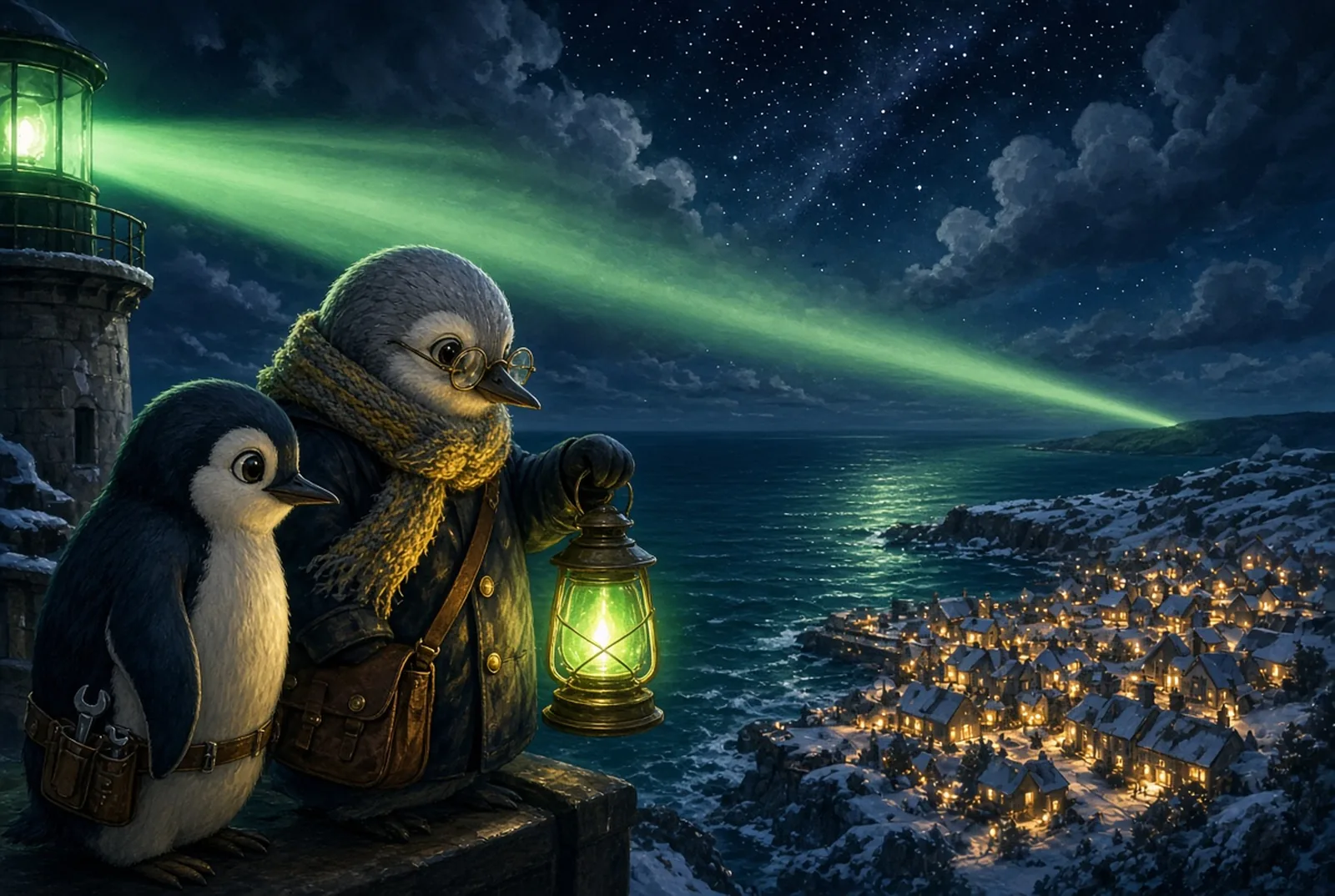
Every penguin in Pebble Bay knew that Pip could fix things.
When a fishing boat’s radio crackled, Pip fixed it. When the school lost its class photographs, Pip found them. And when the village grew tired of keeping track of its own records, Pip helped move everything to the Great Cloud beyond the sea.

It was wonderful—at first. The cloud kept copies of the photographs, remembered everyone’s passwords, and carried messages between the harbor, the clinic, and the school. No one had to think about the little room of humming machines beneath the lighthouse anymore.
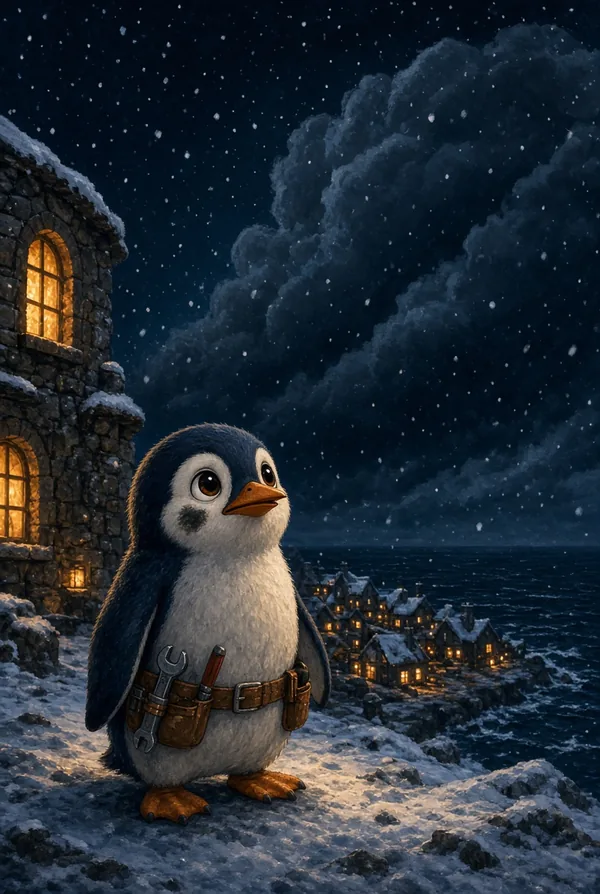
Then, on the longest night of winter, a storm cut Pebble Bay off from the world.
Pip hurried to the clinic. Its staff could not sign in to the records. At the harbor, crews could not open the charts they needed. The school’s pageant photographs were safe somewhere far away, but no one could reach them.
“The cloud hasn’t lost anything,” Pip told the villagers.
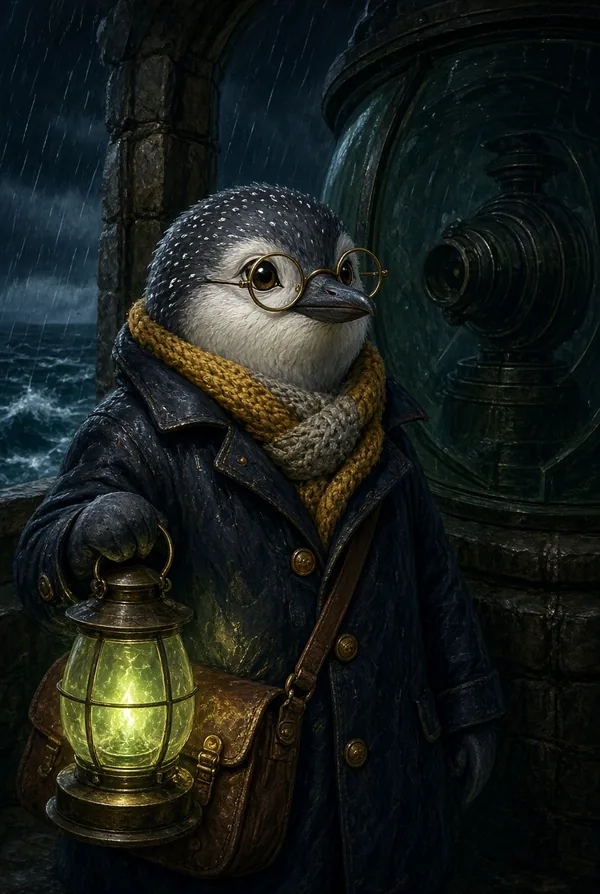
Old Marnie, the lighthouse keeper, looked out at the dark sea. “That may be true,” she said. “But we need it here.”
Pip climbed to the top of the lighthouse, carrying that sentence like a stone. The village had trusted him. He had given them something marvelous, and now, when they needed it most, it was beyond the horizon.
Marnie found him beside the unlit lamp. “Come downstairs,” she said. “I want to show you something.”
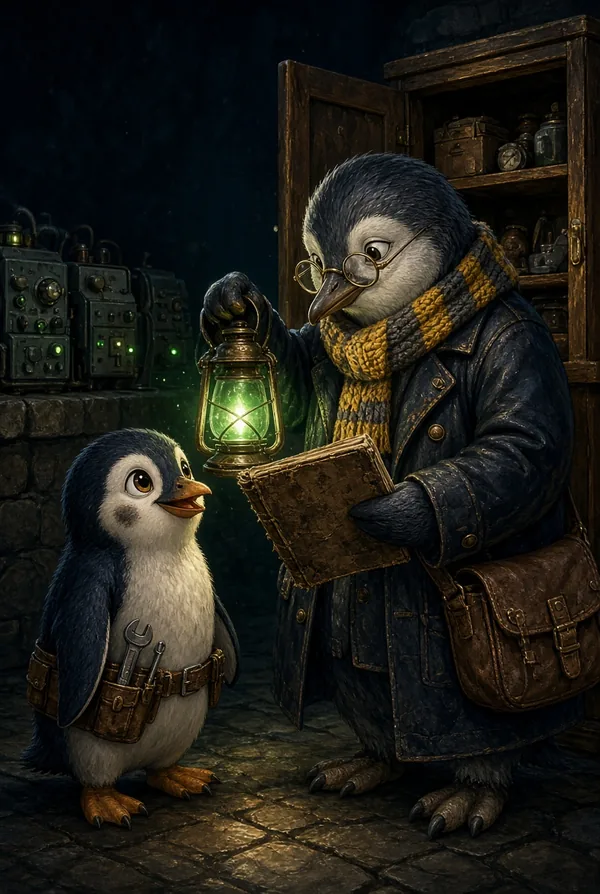
She led him into the old machine room. It smelled of salt, dust, and warm metal. Marnie opened a cabinet and brought out a notebook Pip had filled years earlier. Across the cover, in hurried handwriting, he had written: What if Pebble Bay could keep the good parts?
“What happened to this idea?” she asked.
Pip remembered. He had imagined a system the village could own: copies of important files in separate boxes, another copy kept at the sheltered station across the inlet, accounts for every penguin, and even a box for mail; all under their own roof. Then the Great Cloud arrived. It promised there would be nothing to look after. His notebook went into the cabinet.
“It was only an idea,” Pip said.
“Most good things are,” said Marnie, “until somebody builds them.”
By morning, the storm had passed. Nothing in the Great Cloud had been destroyed. The village’s records returned, just as Pip had promised. But Pip could not forget the night they had been out of reach.
So he took his notebook to the village council.
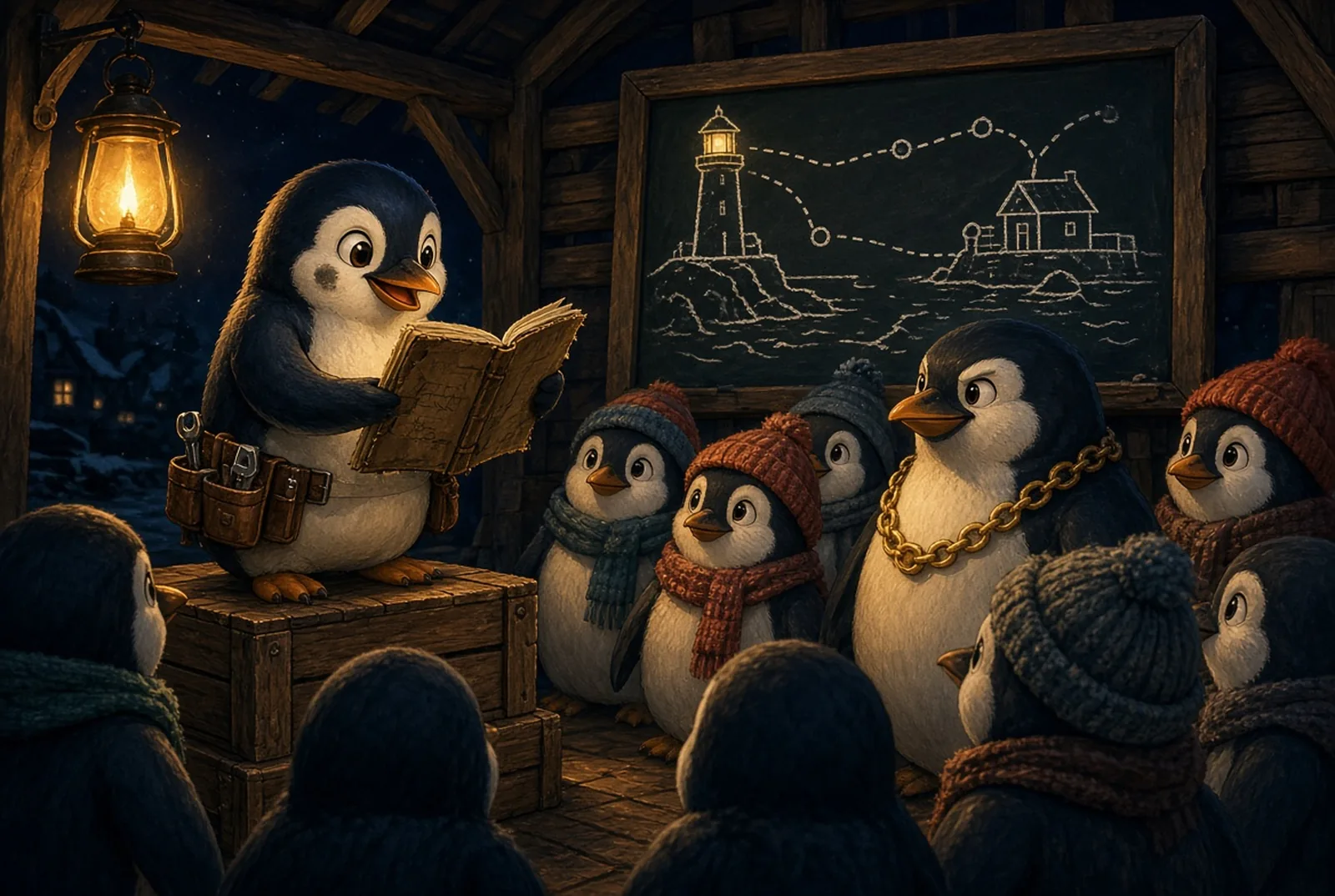
Pip did not promise that storms would stop coming, or that a machine in the lighthouse could never fail. He proposed something better: a system built for failures. If one machine stopped, another could take over. If the lighthouse was damaged, the station across the inlet would have a copy. Each penguin would have one village identity for the services they used. The mail box would live in Pebble Bay, and even that box had a spare box, with sensible plans for when the storms came.
“And who will look after all that?” asked the mayor. “We left because we were tired of looking after the box of records.”
“We were,” said Pip. “So this time we have more than one box, and the boxes look after each other. If one has trouble, another takes its place, and they tell us when they need attention.”
Old Marnie spoke from the back of the hall. “The cloud people weren’t wrong that our records needed watching,” she said. “They only mixed up watching with holding. Let them help us watch, if we like. They never needed to hold.”
The mayor frowned at the notebook. “And what do we call this?”
Marnie looked toward the window and the sea. “Well,” she said. “It’s not the cloud.”
They called it Not the Cloud.
Months later, another storm rolled in. The sea cable failed again. In the small hours the lighthouse machine faltered, as machines do, and the one across the inlet took up its work before anyone was awake to notice. In the morning the harbor crews opened their charts. The clinic staff signed in. The schoolchildren gathered around photographs of last year’s pageant while the wind shook snow against the windows.
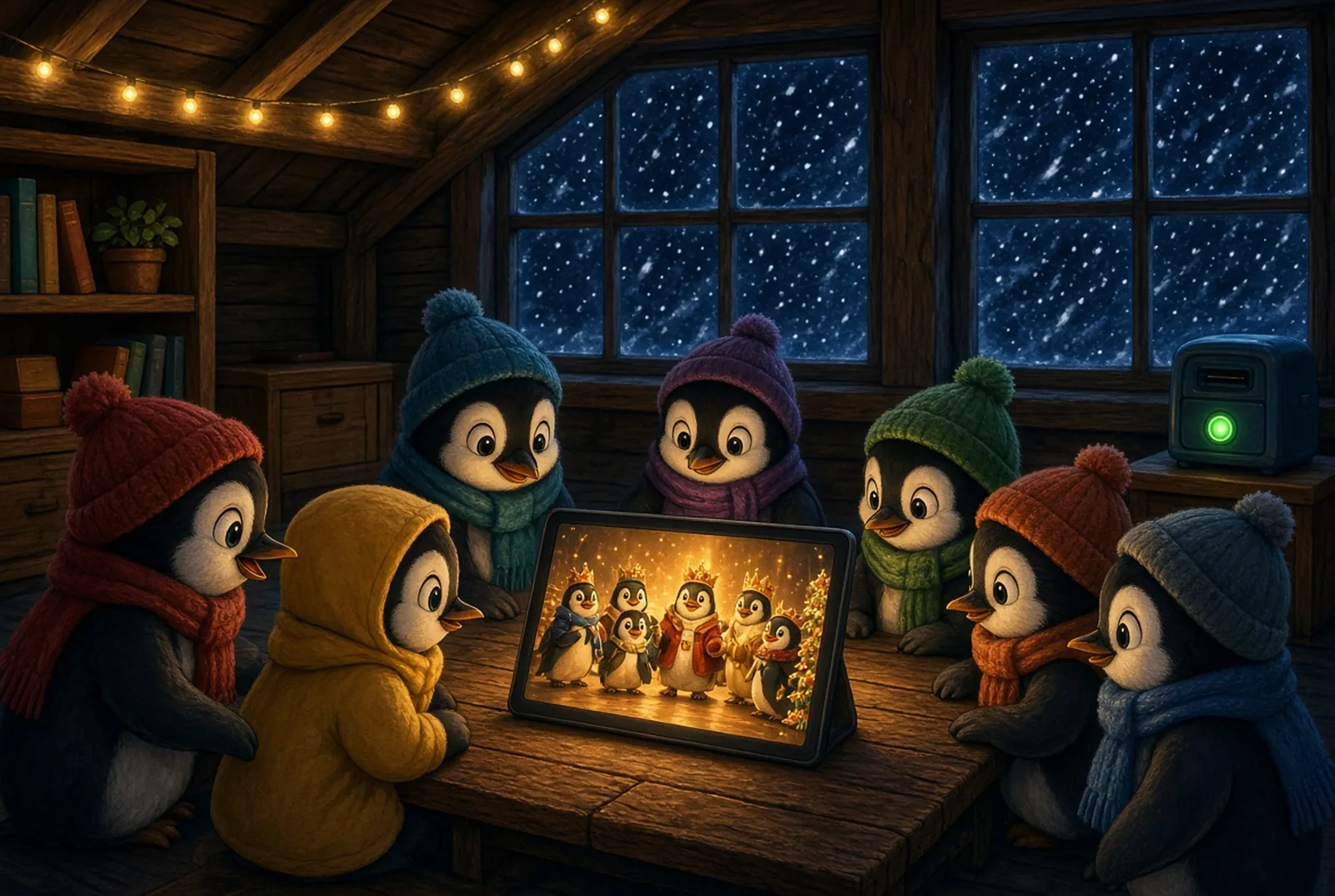
Some messages bound for distant colonies had to wait for the connection to return. Pip made sure everyone knew that. But Pebble Bay could still remember its own stories, care for its neighbors, and carry on its work.
That evening, Pip stood beside Marnie at the lighthouse window. Below them, the village glowed against the snow.
“Funny,” he said. “I thought we were building better boxes for the records.”
Marnie smiled. “You did. Because it was never about the boxes.”
Outside, the clouds parted. The stars were still there—and so was everything the village had chosen to keep close.